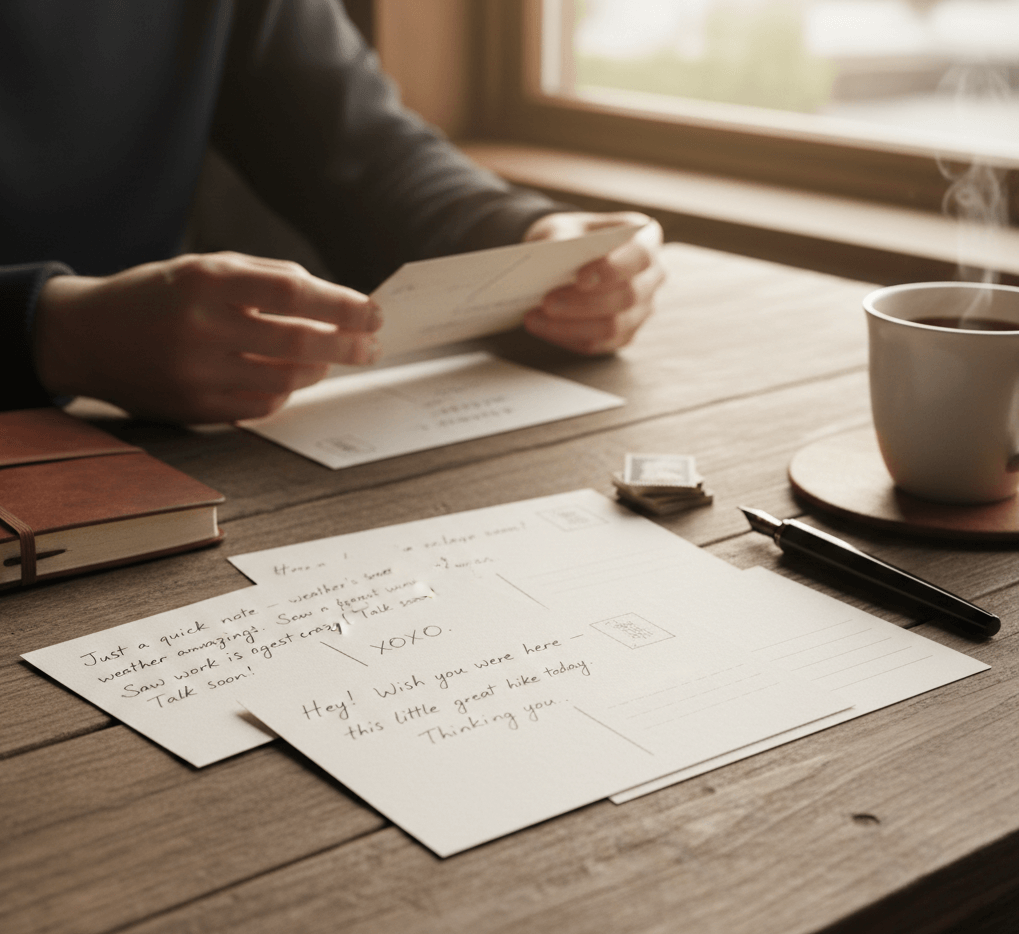
Postcards don’t give you much space, and that’s what makes them surprisingly meaningful. There is something honest about having just a few lines to share a moment, a thought, or a feeling.
Research in communication psychology, including work by Kumar and Epley, shows that people consistently underestimate how much impact a short, sincere message can have. Postcards are a perfect example of this. They are quick to write, simple to send, yet often kept for years.
This guide is designed to help you write postcard messages that feel warm, natural, and human. No overly poetic language, no clichés, no forced sentiment. Just grounded, everyday messages that feel like they came from you.
Why a short postcard message feels more personal than it seems
Researchers in social connection and communication have identified three reasons why short physical messages create an outsized emotional effect.
Small messages act as “connection signals”
Anthropologist Bronisław Malinowski described these as phatic messages - simple expressions like “thinking of you” that maintain relationships over distance. A postcard is exactly that: a small but meaningful signal that someone crossed your mind.
Sensory details make moments more memorable
Psychologist Elizabeth Kensinger’s work on emotional memory shows that when a message includes a small sensory detail (light, sound, temperature, color), the reader creates a more vivid mental picture. Even one detail makes the message feel more real.
Warm language increases closeness
Studies in interpersonal warmth, including research by Williams and Bargh, show that warm, friendly phrasing increases perceived closeness between people. A postcard doesn’t need elaborate wording. A simple “wish you were here” in the right context does the work.
Together, these insights help explain why postcards tend to matter more than their length suggests.
The Amora.cards practical framework for writing any postcard message
A good postcard doesn’t need to follow rigid rules, but a simple structure can help when you’re looking at a blank space.
Here is the approach we recommend:
1. Start with something real from your surroundings
It can be small. A sound, a street corner, the way the light looks, the temperature, the food you just tried. This grounds your message.
Example:
“The evening light is softer here than I expected.”
2. Add a straightforward thought or reaction
Nothing dramatic. Just a genuine thought.
Example:
“It made the whole street feel calm for a moment.”
3. Connect it to the person you’re writing to
This is where the message becomes personal.
Example:
“It reminded me of our last walk together.”
4. End with a warm, simple line
Something honest and unforced.
Example:
“Would have been nice to share it with you.”
These four lines can be shortened, combined, or rearranged, but together they create a message that feels grounded and sincere.
30 postcard message ideas that feel natural and human
Below are message ideas written in the tone you selected: warm, modern, understated, with very subtle touches of humor. All of them are meant to feel like real people talking to each other, not poetry or greeting-card phrases.
For your partner
- “There’s a spot here you would have liked. I caught myself wishing you were walking next to me.”
- “Tried a new dish today. Good, but not as good as sharing it with you would’ve been.”
- “This place is interesting, but it would feel more complete with you here.”
- “Found a quiet corner of the city that reminded me of us. Nothing dramatic, just comfortable.”
- “Saw a couple doing something silly and thought of how much you would’ve laughed.”
- “It’s nice here, but it made me realise I enjoy places more when you’re part of them.”
- “Small moment today made me think of you. Thought I’d send a piece of it your way.”
- “Everything here feels new, but you still ended up in my head more than once.”
For close friends
- “Found a small bar here that feels exactly like the kind of place we’d end up by accident.”
- “Managed to get lost twice in one afternoon. You would’ve appreciated the chaos.”
- “Saw something today that instantly made me think, ‘They’d enjoy this more than I did.’”
- “Sending this so we can add it to our list of small stories to laugh about later.”
- “There’s a café here with terrible chairs but great people-watching. You’d be in your element.”
- “This city has the exact kind of energy you usually bring to places.”
- “Walked past a shop window and immediately thought, ‘They’d have opinions about this.’”
For family
- “Sending a small moment from here. Nothing big, just something I wanted to share.”
- “Found a street that reminded me a bit of our old trips together.”
- “Everything here is going well. Hope things at home feel just as steady.”
- “There’s a calmness here you would’ve liked. Thought I’d send a little of it your way.”
- “This place feels warm in a familiar way. Made me think of home.”
- “Saw something that brought back an old memory. Nice surprise.”
Short and simple messages
These work when you only have a few words left.
- “Thinking of you from here.”
- “Wish you were here for this one.”
- “A small hello from a nice moment.”
- “Sharing a little piece of today.”
- “This made me think of you.”
Lightly humorous, but still grounded
- “Managed to order the wrong thing twice today. You would’ve laughed, loudly.”
- “Got lost again. At this point it’s becoming a personality trait.”
- “There’s too much good food here. I’m sending this as a cry for help.”
- “This place is great, but it’s missing your commentary.”
When you don’t know what to write at all
If you’re completely stuck, use this simple three-part approach that communication researchers describe as a “micro-story”:
- One detail from your surroundings
- One honest feeling or reaction to it
- One line that connects it to the person
Example:
“The street outside is noisy but kind of comforting. It reminded me of evenings when we just sat and talked. Thought I’d send you a bit of that.”
Another version:
“Tried something new today and it didn’t go amazingly, but it made me smile. You came to mind.”
This works even when you have very little time or space.
Want to turn one of these ideas into a real postcard?
If one of the lines above sparked something, or if your own message started forming while reading, you can send it as a real postcard in just a minute.
Try it