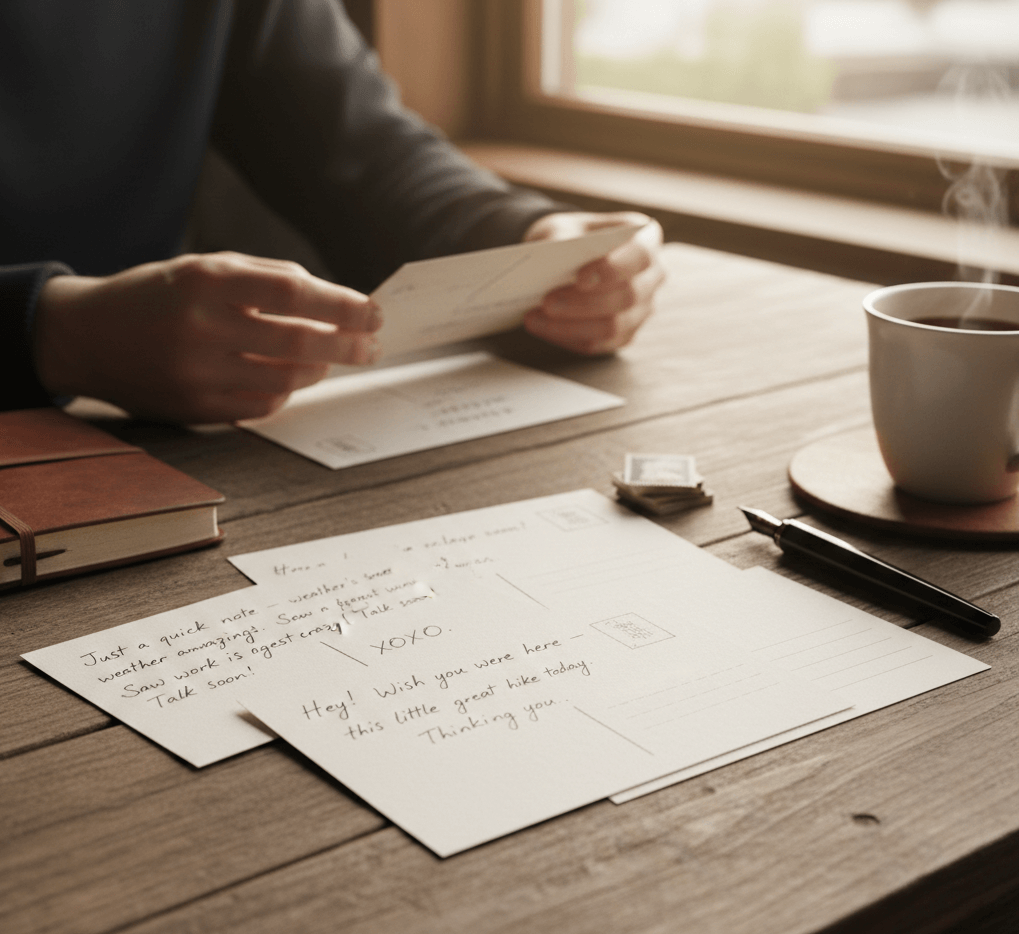
You don’t need a good story to write a good postcard.
If someone asks how your holiday is going, you probably tell them about the weather, where you’re staying and what you did yesterday. You don’t look for a moving memory or a clever way to describe missing them. You just answer.
You can write a postcard that way too. “We’re doing well. The hotel is nice. We’ve mostly been swimming.” That’s a perfectly reasonable start. Someone at home wants to hear how you are, and now they know.
Here’s a way to turn that update into a whole message, followed by examples you can adapt. All the messages below are invented examples, not customer postcards.
Start with the update you’d give on the phone
Try answering three questions:
- How are you getting on?
- What have you been doing?
- What’s one thing you’d tell this person about the trip?
That last thing can be very ordinary: the apartment has a balcony, the sea is colder than you expected, or you finally had a day without setting an alarm. You don’t need an unusual detail. Write about whatever you actually want to tell them.
Here’s how those answers might look together:
Hi Mum,
We’re doing well and enjoying the break. It’s been really warm, so we’ve mostly been swimming and sitting in the shade. Yesterday we took the bus into town and had a look round the market. The hotel is nice and the food’s been good. Still a few places we want to see, but we’re taking it easy.
Lots of love, Anna xx
There’s no big event in that message. It still tells Mum quite a lot: you’re well, you like the hotel and you’re having a restful holiday. That can be the whole purpose of the card.
A beach holiday postcard to a friend
With a friend, you might mention how the holiday has turned out compared with what you planned. You can say you’ve done very little if that’s what happened.
Hi Jess,
Having a lovely time here. We had all these plans to go exploring, but so far we’ve barely left the beach. There’s a little place near the apartment where we’ve been having lunch most days. I keep ordering the same thing because it’s good and I can’t be bothered to choose. We did hire bikes yesterday, though, and went along the coast for a bit. Hope things are going well with you.
Love, Sarah x
The lunch detail is something Sarah could easily mention in conversation. If you’d never tell your friend about lunch, leave it out. You can tell them about the swimming instead.
A city break postcard to your parents
You don’t have to list every sight you’ve visited. Pick a couple of things you’ve done, then say how you’re finding the place.
Hi Mum and Dad,
We’re having a good time in Lisbon. The apartment is small but it’s in a handy spot, so we’ve been walking almost everywhere. We went to the castle yesterday and stopped for lunch on the way back. There are a lot more hills than I was expecting! Today we’ve had a slower start and just been out for coffee so far. Hope you’re both well and the garden’s doing alright.
Lots of love, Ben and Lucy
It’s fine to mention a small inconvenience. “The room’s a bit noisy” or “We got soaked yesterday” doesn’t mean you’re complaining about the whole trip. You’re telling them how it’s going.
A family holiday postcard to grandparents
If you’re writing about a trip with children, you can include what they’ve been enjoying. There’s no need to turn it into a milestone or a sentimental moment.
Dear Gran and Grandad,
We’re all well and having a nice week away. The children have been in the pool every day. Ella’s getting much more confident in the water, and Max is mostly interested in when we’re getting ice cream. We went down to the harbour yesterday and watched the boats for a while. The apartment has a washing machine, which has already come in very useful. Hope you’re both keeping well.
Lots of love from all of us, Kate, Tom, Ella and Max
Write whatever you’d normally tell your grandparents. If that’s more about the food or the weather than the children, that’s fine too. There are more relationship-specific examples in our guide to postcards for parents, siblings and grandparents.
A rainy holiday postcard
You don’t have to make the trip sound better than it is. You can be enjoying the break and fed up with the rain at the same time.
Hi Dan,
It’s rained for most of the week, so the walking boots haven’t had much use. We managed one short walk by the lake, then spent yesterday in town looking round the shops. The cottage is comfortable, though, and we’ve been cooking, reading and watching films in the evenings. Quite nice having nowhere we need to be. Hope work’s going alright.
Love, Alex
If the best part of the holiday has been sitting indoors reading, you can say that. You don’t owe anyone an exciting travel report.
What if you only want to write a few lines?
A greeting, a short update and your name can be enough. You don’t have to fill the card.
Hi Dad,
All good here. We’ve had lovely weather and have been spending most days by the sea. Went out for a really good meal last night. Hope you’re well and enjoying a bit of sunshine too.
Love, Emma x
Or, for a walking holiday:
Hi Nan,
Having a lovely time in the Lakes. We’ve been out walking most days and found a nice café in the village. The house we’re staying in is very comfortable. Hope you’re keeping well.
Lots of love, Sam xx
“Having a lovely time” is fine if you’re having a lovely time. Familiar phrases belong in everyday messages. You don’t need to replace them all with something original.
Leave arrangements for a separate message
Write your location and the date if you’d like the reader to know when you wrote the card. They can enjoy the update even if you’re home by the time they read it.
Keep anything that needs a quick reply in a separate call or message. “Can you pick us up on Sunday?” needs to reach someone in time; a holiday postcard shouldn’t carry that job.
You can still mention plans as part of your update: “We’re hoping to visit the old town” makes sense as something you were looking forward to when you wrote. You don’t need to predict when the card will arrive.
Write your own version
Before you copy an example, change it to fit your trip. Replace the hotel with your campsite, the swimming with your walks, and the market with whatever you did. Delete anything you wouldn’t normally say. Keep your usual greeting and sign-off.
If you’re using a holiday photo for the front, the message can tell the reader a little about it: where you were, what you were doing, or whether you liked the place. It doesn’t need to describe everything in the picture.
Start with “We’re doing well…” and write the next few things you’d tell them on the phone. Read it back once. If it sounds like you, you have your message.
Save this guide for your next trip, or choose one person and write them an update while it’s on your mind.