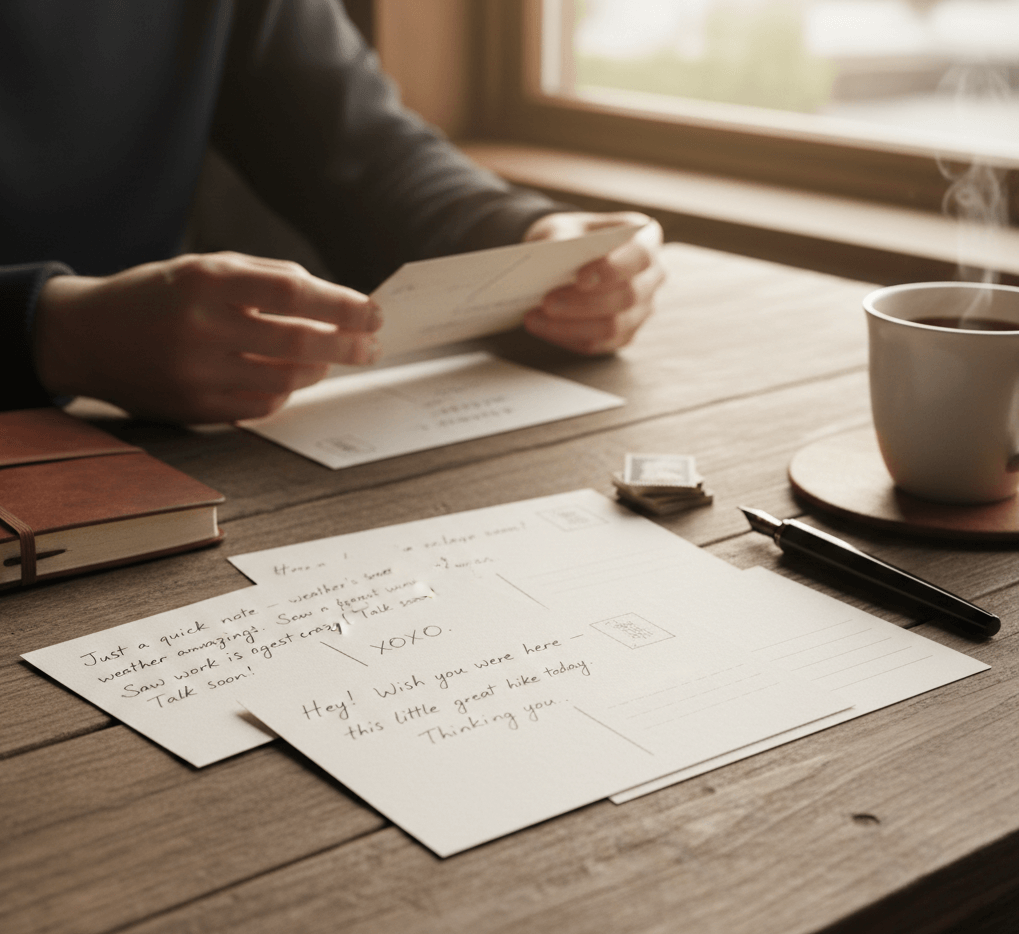
You bought the postcard. You took the photo. Now you're staring at the white space on the back, and you've been staring at it for ten minutes. That's where almost everyone gets stuck.
The problem isn't that you don't know the person well enough. It's that you've quietly decided this card needs to be good. Memorable. Worth keeping. So you're trying to write something that sounds like a postcard instead of writing what you'd actually say.
Here's the only rule that matters: one specific thing beats anything general.
"Thinking of you from Berlin, hope you're well!"
Forgettable. That could have been sent by anyone, to anyone.
"At a café opposite the train station. Same coffee as Vienna last year. I keep thinking about that whole evening."
That one lands. It names a place. It calls back a memory only the two of you have. It implies a feeling without spelling it out. Specific beats sweet, every time.
The move when your brain is empty
If you genuinely can't think of anything, do this:
- Write the most boring, true sentence you can about where you are or what you're doing.
- Add one thought you've had today.
- Sign your name.
That's a postcard. It works because it's true.
"On a train. Cold. The two people opposite me are arguing in what I think is Finnish. I've been thinking about that conversation we had at Christmas. — Sam"
You don't have to be on a trip. You don't have to be having a profound day. You need to write something that came out of your head on this day. That's the entire point of the format.
What real postcards actually sound like
These aren't templates. They're not arranged by length or relationship. They're things real people might actually write, to real people they care about. Read them out loud — if they sound like a person talking, they're working.
To a parent:
"Mum — at the café you'd hate (everyone on laptops, no proper milk). The coffee's good though. Was thinking about coming up the weekend after next, if that works for you. Bring the secateurs when I do. Love, R."
The detail about the milk is doing the work. The plan at the end gives the card a job.
To a close friend, after a long silence:
"I know it's been a while. I've thought about you a lot, just not when my phone was in my hand. Anyway — here. Hope you're well. Tell me about that thing your sister was doing. xx"
Addresses the gap. Doesn't over-apologise. Asks something real, so they'll write back.
To a partner:
"Walked past a bookshop today that you would have made me go inside. So I went in. Picked up the heaviest book I could find. Didn't buy it. You'd have. Anyway — miss you. Home Sunday."
The bit they share with no one else. A practical ending so it doesn't drift.
To a grandparent:
"Granny — this is from the airport because I knew I'd forget otherwise. We're driving up to Edinburgh next month — me, Liz, and the kids. Mia keeps asking when she gets to see you again. Soon. Properly. Love, R."
Concrete, names the children, promises something real and soon. Grandparents keep these.
Short, on purpose:
"Hi. I'm bad at this. Miss you though. — J."
Sometimes that's the whole card. It's better than the one you didn't send.
Long, on purpose, to a sibling:
"Dan — it's 7am here and I've been up since 4 because of the time difference, which is genuinely terrible. The hotel breakfast was three slices of cake and a yoghurt and they had no spoons so I ate the yoghurt with my fingers like an animal. Anyway. The actual reason I'm writing — I keep thinking about what you said at the wedding, about Dad. You were right. I just didn't say so at the time because I'm rubbish at that kind of thing. So. Yeah. You were right. Hope work's okay. — Ben"
Filling the entire back of the card is not too much. People don't open a postcard packed with handwriting and think "this is excessive." They feel valued. They keep it.
No reason at all:
"No reason for this. Saw your face in my camera roll and thought I'd send something that wasn't a meme for once. — A"
Out of the blue is often the best reason. A card on a random Wednesday is more memorable than a birthday card.
"But I'm not on a trip"
You don't have to be. Half the best postcards in existence were written at someone's kitchen table on a Wednesday afternoon. The photo on the front can be anything — a holiday picture from three years ago, the dog, your kid, the cake you just made, the view from your window this morning. The message is whatever you want to say. The event is that a physical card is going to arrive in their letterbox.
A birthday card is expected. A card on a random Tuesday isn't. That's why the random Tuesday one ends up on the fridge for a year.
"I don't know which photo to use"
Open your camera roll. Scroll until something stops you. That's the photo.
It doesn't need to be your best photograph. It needs to be one that means something to at least one of you — or one you think they'd be happy to see propped up on their kitchen counter for a few months.
Four things to stop doing
- Stop rereading it. A postcard is supposed to feel like it was written quickly, because it was. Polishing it five times kills the warmth that made you want to send it in the first place.
- Stop writing "thinking of you" if that's the whole sentence. It's the postcard equivalent of "k". Either say what specifically made you think of them, or drop the line and start with something else.
- Stop worrying about your handwriting. It gets typeset on the card — your handwriting isn't on it.
- Stop trying to be funny if you're not feeling funny. Forced jokes read as forced. Honest beats clever, always.
The thing nobody tells you
A bad postcard you actually sent beats the perfect one still sitting on your desk.
You're not going to write the perfect line. The person receiving it doesn't need you to. What they need is a real, physical thing with their name on it, that they can hold and put somewhere visible. The card is the message. The words are the bonus.
Now go write it.